
Black Car Care on Long Island: Swirl Marks & Water Spots
Quick answer
Black and dark cars show every wash mark, water spot, and speck of dust the moment sun hits them — which is why the routine that works on a silver car ruins a black one. The fix isn't a different shampoo, it's a different process: never a tunnel wash, two-bucket hand wash with a clean mitt, never towel-dry with anything that's touched the ground, and a slick spray ceramic sealant that prevents water-spotting and gives wash marks nothing to hold onto. Done right, a black car on Long Island stays wet-looking and mirror-clean year-round. Washed the usual way, black paint hazes over with swirls within months and needs paint correction — a machine-polishing specialty Al's Auto Detailing does not offer — to come back. Our job is prevention: keeping swirls from ever being installed.
By Al Alvarez
Owner & master detailer · 6+ years on Long Island
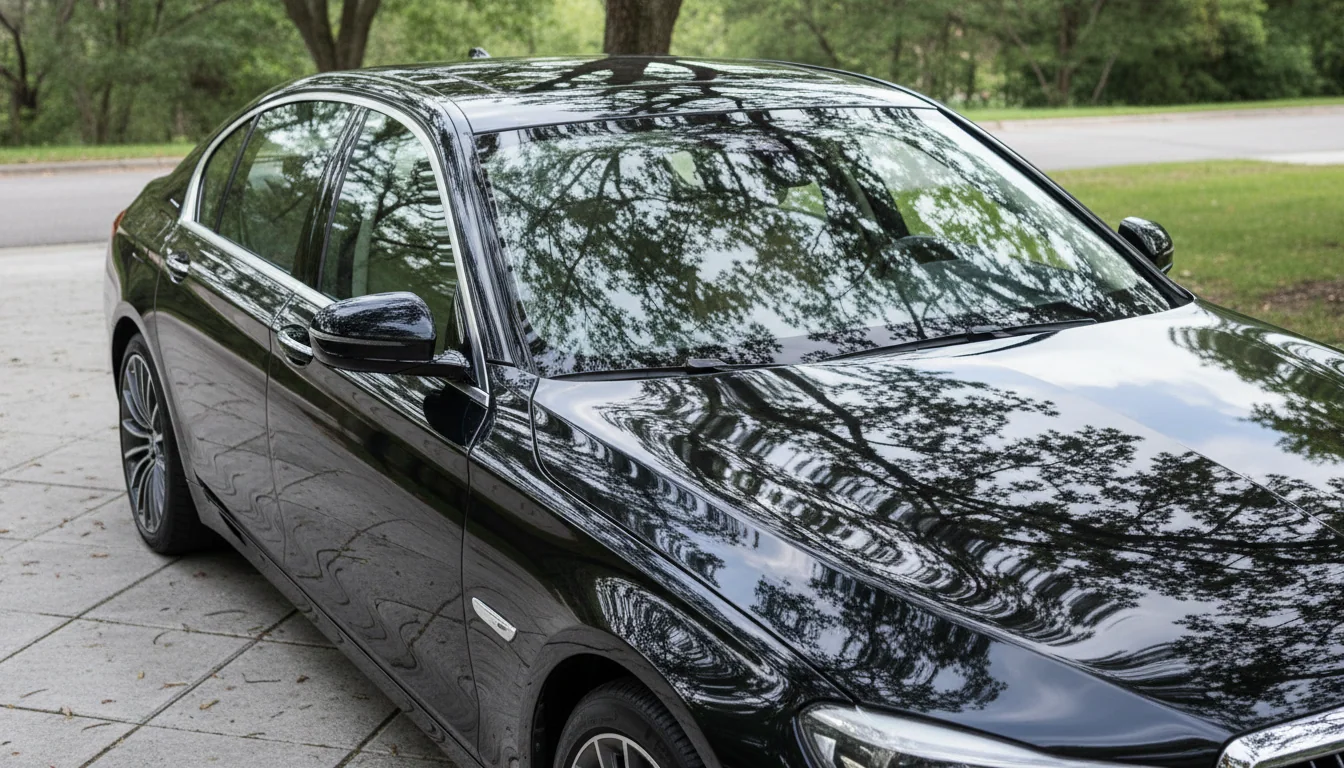
Park a freshly washed black car next to a silver one in the same driveway. Both were washed the same morning, with the same process, by the same person. Walk around them in the afternoon sun. The silver car looks clean. The black car shows every wash mark, every fingerprint, every spot of dust that landed in the last six hours. This is the problem with black paint — and the reason black cars on Long Island either look incredible or look terrible, with very little in between.
What separates the two outcomes isn’t luck. It’s process. Here’s what’s actually happening to dark paint on the Island and the maintenance routine that keeps it sharp.
Why black paint is the hardest color to maintain
Black, dark blue, dark gray, and dark red paint all absorb light. Light-colored paint reflects most of what hits it, which masks the small surface defects that exist on every car. Dark paint reflects very little, so any defect on the clear coat — a scratch, a water spot, a swirl mark — reflects light differently than the surrounding paint and becomes visible.
The defects are the same on every color. The visibility is what changes. This means:
- Swirl marks that are invisible on a silver Camry are obvious on a black BMW washed the same way.
- Water spots that disappear into a white paint disappear into nothing on a black hood — they sit as bright rings.
- Dust and pollen that you can’t see on a beige interior shows as a film on a black trunk lid within hours of a wash.
None of this is unique to expensive cars. A black 2018 Civic and a black 2024 Range Rover have the same surface-physics problem. The Range Rover gets more attention to it.
The five things that cause swirl marks
Every swirl mark on a black car came from one of five sources:
- Automatic tunnel washes. The brushes or cloth mitts at most automatic washes have touched hundreds of cars. They carry grit and dragging that grit across paint installs a visible swirl pattern. One pass through a tunnel wash on a black car is enough to require a correction afterward. Full breakdown in hand wash vs. tunnel vs. mobile detailing.
- Single-bucket washes. Washing with one bucket means the dirt that comes off the car goes into the same bucket the wash mitt rinses in. Every successive panel gets washed with progressively dirtier water. The grit ends up dragged back across the paint.
- Drying with the wrong towel. Towels that have touched the ground, been used on wheels, or been washed with anything other than detailing-grade microfiber laundry pick up contamination that scratches paint during the drying step. Drying is where 60%+ of swirl marks are installed on cars that were washed correctly.
- Wiping dust off a dry car. Reaching across the hood with a hand or a shirt to wipe a smudge off dry paint is grinding whatever dust is on the surface across the clear coat. It always shows on black paint. Use a quick detailer spray and a clean microfiber instead.
- Sponges and old wash mitts. Cellulose sponges hold grit. Wash mitts that have been used dozens of times start holding embedded dirt that the wash process can’t release.
Eliminate these five sources and the wash process stops adding new swirl marks. That’s the whole point of the proper process.
The proper black-car wash process
The exterior detail and full detail services use this exact process — and any owner washing at home can replicate it:
- Pre-rinse. Pressure rinse from top down. Get as much loose contamination off as possible before anything touches the paint.
- Foam pre-soak. Thick foam dwell for 5-10 minutes. Encapsulates remaining dirt so the wash mitt slides through suds instead of grinding particles.
- Two-bucket hand wash. Wash bucket with pH-balanced shampoo, rinse bucket with plain water, grit guards in both. Wash mitt rinses in the rinse bucket between every panel.
- Top down, light pressure. Cleanest panels first (roof, hood), dirtiest last (lower rockers). Light pressure — the chemistry does the work.
- Wheels separately, with a separate mitt. Wheels are the dirtiest part of the car and have their own mitt that never touches body paint.
- Thorough rinse. Full top-down rinse. No leftover soap.
- Pat-dry with plush microfiber. Plush microfiber drying towels, dedicated to drying, never used elsewhere. Pat where possible instead of dragging.
- Quick detailer or spray sealant. Light spray-on protectant restores slickness and adds a sacrificial layer.
This is also the process behind the mobile detailing vs. car wash for luxury vehicles comparison — the same logic applies to any car where the paint matters.
Water spots are the second problem
Water spots are mineral deposits left behind when water dries on paint. They show on every color. On black paint, they show in a way that doesn’t allow ignoring them.
Long Island tap water is moderately hard — enough mineral content to leave spots if water dries on paint in the sun. The conditions that cause them:
- Washing in direct sunlight.
- Hose rinse and walking away — water dries on lower panels and trim.
- Sprinkler overspray on cars parked in driveways.
- Rain after a dry stretch — the first drops pick up airborne dust and dry as ringed spots.
- Pollen-season morning dew on horizontal panels.
The prevention: dry the car immediately after washing, park where sprinklers don’t reach, and seal the paint with something hydrophobic enough that water beads tight and runs off before it dries. The spray ceramic sealant upgrade handles the third one — water beads tight, runs off fast, and the few drops that remain dry without ring marks because the surface is too slick to anchor the mineral.
The maintenance pattern for black cars on Long Island
The cadence that works:
- Weekly or bi-weekly maintenance wash. Quick hand wash or weekly quick detail subscription to keep contamination from building. Frequency matters because contamination on dark paint becomes harder to remove the longer it sits.
- Quarterly full detail with ceramic sealant. Decontaminates and reseals the paint. The slick surface reduces wash-induced marring and stretches the interval between needing correction.
- Annual paint correction, if the paint has gone too far. Daily-driven black cars in their second year or older often benefit from a one-step correction once a year — machine polishing that levels the clear coat below the swirl depth. It’s a separate specialty from detailing; send us a photo and we’ll sort out getting it handled.
- Avoid the tunnel wash, every time. Even a single tunnel pass between proper details undoes most of what the previous detail accomplished.
This is more work than maintaining a silver car. The result is a black car that looks wet and mirror-clean instead of hazy and tired.
Where this matters most on the Island
Concentrated wherever luxury dark cars live: Garden City, Manhasset, Roslyn, Cold Spring Harbor, and Lloyd Harbor on the North Shore; the village sections of East Hampton, Southampton, Sag Harbor, and Bridgehampton on the East End. Black BMW, Mercedes, Range Rover, and Porsche are the dark cars we detail most often out here — followed by black trucks (Tahoe, Yukon, Range Rover), which have the most surface area to keep clean.
The Hamptons and North Fork add the extra layer of salt air and tree sap — covered in salt air paint damage on the East End and spring pollen and tree sap. Black cars in those areas need more frequent service than the same car would need on the South Shore inland.
Booking
For a proper exterior detail with spray ceramic sealant, or a maintenance plan on a black or dark car — text year/make/model with a photo of the paint in sunlight to (631) 559-9235, or use /contact. The sunlight photo lets us see what’s actually in the clear coat and quote the right service the first time. If the photo shows swirls deep enough to need paint correction, we’ll tell you straight — that’s machine polishing, not detailing, and it isn’t something we do in-house. Send the photo anyway and we’ll get it sorted. Mobile across Nassau, Suffolk, the Hamptons, and the North Fork.