
Convertible Top Care for Hamptons Summer: Cloth, Vinyl, and Mildew
Quick answer
Convertible tops on Long Island take a beating between June and September — salt air, sunscreen overspray, tree sap from beach-house driveways, and humidity that grows mildew under any folded section. Cloth tops (Mercedes SL, BMW 4-Series, Porsche Boxster, Audi A5) and vinyl tops (older Mustangs, Miatas, Jeep soft tops) need different cleaners and different protectants — the wrong product on the wrong material strips the water-repellent coating and accelerates the damage. The right service is a $40 standalone or bundled-with-detail cleaning that lifts contamination, kills early mildew, and re-applies a fabric or vinyl protectant. Done in May or June, it carries the top through Labor Day. Done as an emergency in September after stains set, it's twice the work and some staining is permanent.
By Al Alvarez
Owner & master detailer · 6+ years on Long Island
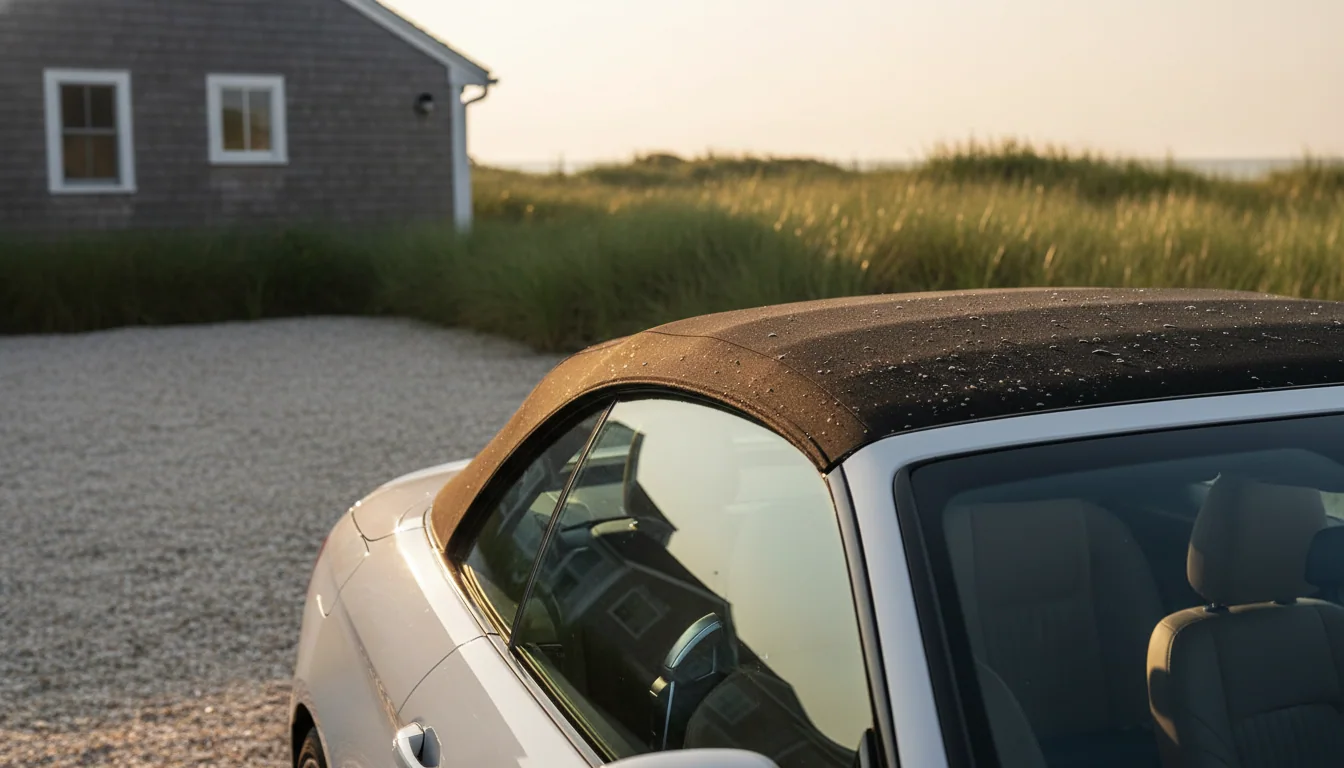
A convertible parked in a Sag Harbor driveway under a black locust from late June through August picks up sap, pollen residue, salt mist off the bay, sunscreen overspray from the people who got in after the beach, and just enough humidity in the cool morning hours to start growing mildew at every seam. By Labor Day, the top is dull, slightly stained, and the water-beading is gone.
Convertible tops don’t need much, but they need the right thing at the right time. Here’s what’s actually happening to a Hamptons convertible top over summer and the small service that prevents the big repair.
Cloth tops and vinyl tops are different materials
The first thing to know — and the thing most generic detailing products get wrong — is that cloth and vinyl convertible tops are not interchangeable.
Cloth tops are a multi-layer construction: an outer canvas (typically a Sonnenland or Twillfast weave on European cars), an inner waterproof membrane, and a fabric headliner. The outer canvas is woven, breathable, and treated with a water-repellent finish at the factory. This is what’s on essentially every luxury convertible built since 2005.
Vinyl tops are a single layer of textured vinyl bonded to a fabric backing. Solid, non-porous, smooth to the touch. This is what’s on most classic American convertibles, older Mazda Miatas, most Jeep soft tops, and a handful of newer budget convertibles.
The cleaners are different. The protectants are different. Putting a vinyl protectant on a cloth top is a mistake we see constantly — it traps moisture in the breathable canvas, accelerates mildew, and discolors the fabric over time. Putting a cloth-top cleaner on vinyl just doesn’t do much, but vinyl protectant on cloth actively damages it.
What summer does to a convertible top on the East End
The damage comes from four sources, all peaking between June and September:
Sunscreen and body oil. Anyone who gets in the car after the beach brings residue. Over a summer, the headrest area and seat-backs build up a film. On cloth tops, it migrates into the fabric and feeds mildew. The same problem hits leather seats — covered in pet hair, smoke, and stain removal for the interior side.
Tree sap and aphid honeydew. Black locust, mulberry, and ornamental fruit trees are common in older Hamptons properties. Sap drops on the top, hardens, and on vinyl wipes off relatively easily — on cloth it embeds into the weave and resists removal once it’s set.
Salt air and salt mist. Cars parked within a mile of the bay or ocean pick up airborne salt. Salt on cloth holds moisture longer than untreated areas, which is one of the silent drivers of mildew along the South Shore and East End.
Humidity and folded storage. Convertibles stored top-down in the garage between weekend uses are the worst offenders. The folded sections never fully dry, the dark folds become anaerobic, and mildew starts at the deepest creases first.
The combination is what makes a perfectly clean top in May look hazy and faintly stained by Labor Day even though nothing dramatic happened.
Why the $40 cleaning is the right summer move
The convertible top cleaning service runs $40 standalone or bundles with a full detail at the same price. The service:
- Light vacuum. Pulls loose dirt, pollen, and surface debris out of the weave before any wet step. Important on cloth — pre-vacuuming prevents grinding contamination into the fabric during cleaning.
- Material-specific cleaner application. Cloth gets a pH-balanced fabric cleaner formulated for canvas-style convertible tops. Vinyl gets a vinyl-safe degreaser. No bleach, no all-purpose cleaner, no dish soap — these strip the factory finishes and accelerate failure.
- Soft-bristle agitation. A horsehair or soft synthetic brush works the cleaner into the weave or texture. Heavy pressure is unnecessary — dwell time does most of the work.
- Mildew kill on cloth tops. A separate fabric-safe biocide treats any visible early mildew at seams, fold creases, and the rear window surround. Catches it before it sets into the fabric.
- Low-pressure rinse. Hose-pressure rinse from multiple angles to flush out lifted contamination. No pressure washer.
- Material-matched protectant. Cloth tops get a fabric-safe water-repellent re-application that restores beading and breathability. Vinyl tops get a UV-stable vinyl protectant that prevents cracking and fading.
- Dry under cover before use. Cloth tops should dry fully before the top is operated or the car parked top-down.
Total time on the cleaning is about 30-45 minutes, scheduled as an add-on to whichever detail is already on the books.
Timing — and why May or June is the right window
Two windows work:
- Late May to mid-June. Before the heaviest summer use, ahead of the worst sap and humidity weeks, and the protectant has time to fully cure before salt air and intensive sun exposure. Bundled with a full detail at the start of summer, this is the standard play.
- Early September. After the worst of summer, before the top sits for fall and winter. Cleans off the season’s accumulation and prevents mildew growth during the storage months.
Owners who skip the summer-start cleaning and try to clean the top in September after staining has set spend significantly more time on the same job and accept that some stains won’t fully come out. Set mildew leaves shadows. Embedded sap leaves rings. The cost of doing it right at the start of the season is less than the cost of doing it as damage control at the end.
Where this matters most on Long Island
Concentrated in the convertible-heavy markets: Southampton, East Hampton, Sag Harbor, Bridgehampton, Watermill, and Sagaponack on the East End. Garden City, Manhasset, Roslyn, Cold Spring Harbor, and Lloyd Harbor on the North Shore. North Fork wineries see a steady mix of Boxsters and BMW 4-Series from late spring through fall. The combination of luxury convertible density, beach-house driveways, and salt-air proximity makes the East End the hardest service area for cloth top maintenance specifically.
Cars stored at second homes — driven a few weekends a month, top up and down constantly, parked under trees — show the most damage. Cars stored at year-round homes and garaged in the off-season show the least.
What this pairs well with on summer detail visits
Common bundles we run at the start of summer:
- Full detail + convertible top cleaning + ceramic sealant upgrade. The standard “prep the car for summer” package. About 4-5 hours on-site, covers paint, interior, top, and seals everything.
- Quick detail + convertible top cleaning. Maintenance cadence between full details for owners doing weekly upkeep — covered in auto detailing subscription plans.
- Interior detail + convertible top cleaning + leather conditioning. For cars where the cabin took the worst of the season. The interior vs. full detail breakdown covers when this is the right call instead of the full.
Booking
Text the car’s year and model with a photo of the top to (631) 559-9235, or use /contact. Two photos — top up and top down if possible — let us confirm whether the top is cloth or vinyl and flag any early mildew or seam issues before we arrive. Mobile service across Nassau, Suffolk, the Hamptons, and the North Fork.