
Foggy Headlights on Long Island: When Restoration Beats Replacement
Quick answer
Foggy or yellowed headlights on Long Island cars are almost always UV damage to the clear coat on the lens — not damage to the plastic underneath. A proper restoration wet-sands the failed coating off, polishes the lens back to optical clarity, and seals it with a UV-resistant clear coat that holds for 1-2 years. The service runs $75 standalone or $60 added to any detail, takes about an hour, and restores measurable night-driving light output. Replacement lenses start at $400 per side on most cars and run over $1,500 on luxury vehicles with projector or LED assemblies, so restoration is the right call unless the lens is cracked, internally fogged, or the plastic itself has crazed past polish depth.
By Al Alvarez
Owner & master detailer · 6+ years on Long Island
Drive any Long Island parking lot at night and the proof is everywhere: cars five years and older with headlights that throw a foggy yellow glow instead of a clean white beam. The owners assume the bulbs are failing and replace the bulbs. The bulbs aren’t the problem. The lens is.
This is the most common, most fixable, and most overlooked problem on cars in their second half of life on the Island. Here’s what’s actually happening, when restoration is the right call, and when it isn’t.
What “foggy headlights” actually means
Modern headlight lenses are polycarbonate plastic — light, impact-resistant, and the right material for the housing. Polycarbonate has one weakness: it degrades fast under UV light. To prevent that, every factory headlight ships with a thin clear protective coating on the outside of the lens.
That coating fails first. UV breaks it down. Salt air accelerates it. Cars parked outdoors get the most exposure. Once the coating starts to fail, the polycarbonate underneath starts oxidizing too — the surface yellows, microscopic pits form, and the lens scatters light instead of focusing it.
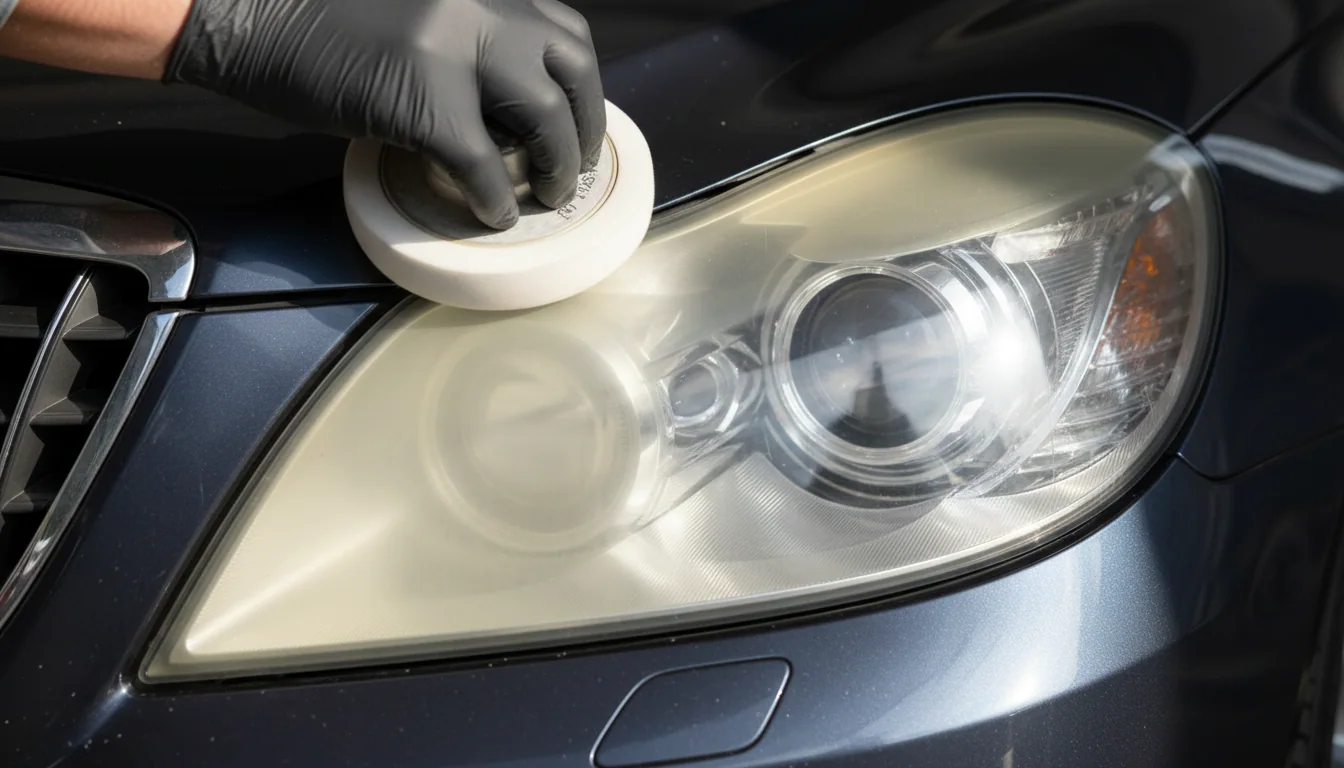
So when you look at a foggy headlight, you’re not looking at damaged plastic — you’re looking at a failed thin coating on top of mostly-fine plastic. That’s why restoration works: remove the failed coating, polish the underlying plastic clear, and seal it back up.
It’s also why the cheap parts store kits give the service a bad name. Polishing alone removes the factory coating but doesn’t replace it. The bare polycarbonate yellows again in three to six months. The whole job depends on the sealing step.
When restoration works — and when it doesn’t
The restoration works on the common Long Island failure mode: outer-surface yellowing and haze on intact lenses. That’s 80%+ of foggy headlights you’ll see on the Island.
It does not work when:
- The lens is cracked. A crack lets moisture into the housing and won’t seal back up. Replacement.
- There’s condensation or moisture inside the lens. That means the housing seal has failed. Restoration cleans the outside of a lens that’s compromised on the inside. Replacement.
- The plastic has crazed. Look for fine spider-web crack patterns inside the plastic itself — different from surface haze. Crazing means UV damage has penetrated past polish depth. Replacement.
- The reflectors inside are tarnished. Sometimes the outside lens is clear but the silvered reflector behind it has degraded and lost its mirror finish. Restoration won’t help.
The way to check at home: look at the lens in direct sunlight from a few angles. Surface haze that you can see through to the structure underneath is the candidate for restoration. Damage that looks like it’s inside the lens is not.
The cost comparison that makes the decision
A proper restoration is $75 standalone or $60 added to any detail, takes about an hour, and lasts 1-2 years.
Replacement headlight assemblies range:
- Common sedans and SUVs: $300-600 per side for the assembly, plus install. Often $800-1,200 done at a shop.
- Trucks with reflector-style halogens: $400-700 per side.
- Luxury cars with projector or HID assemblies: $1,200-2,500 per side. Mercedes, BMW, Lexus, and Audi headlight assemblies routinely cross $2,000 each.
- Cars with adaptive or LED matrix headlights: $2,500-5,000+ per side. These are the assemblies that make people drive around with foggy headlights because they can’t justify the replacement cost.
For 80%+ of cases, the $75 restoration is the answer. For the other 20% where the lens is structurally compromised, restoration is wasted money — replace.
Why this matters more than people think
Headlight haze isn’t just cosmetic. The yellowed coating scatters light. The same bulb pushing the same wattage throws significantly less usable beam onto the road. Effective night-driving light output drops measurably — on heavily yellowed lenses, by 50% or more.
That shows up most on the back roads off Sunrise Highway, on Montauk Highway past Bridgehampton, and on the dark sections of 25A from Cold Spring Harbor east. Cars with restored headlights see further, sooner. Insurance claims data and safety studies both correlate headlight clarity with reduced night-crash incidence.
It also shows up at the next sale of the car. Yellow headlights are one of the few defects every car shopper notices immediately and reads as “neglected.” The restoration is the highest visual-value, lowest-cost service we offer for pre-sale prep — covered in pre-sale car detailing on Long Island.
The process — and why each step matters
The headlight restoration service runs in six steps:
- Mask off the paint and trim. Tape around the headlight to protect surrounding paint, chrome, and rubber from sanding scratches and polish splatter.
- Wet-sand the failed UV coating. Step through 1500, 2000, and 3000 grit wet sandpaper. The goal is to remove the degraded factory coating without gouging the polycarbonate.
- Machine polish to optical clarity. Foam polishing pad with a fine cut polish. After this step the lens looks brand-new.
- Clean and prep with isopropyl alcohol. Remove polishing oils. The UV sealant won’t bond properly if any polish residue remains.
- Apply UV-resistant clear sealant. This is the step that separates a restoration that lasts 1-2 years from a polish job that re-yellows in months. A proper curable UV-stable coating bonds to the polycarbonate and replaces what the factory coating was doing.
- Cure and inspect. Final inspection checks clarity, coverage, and a clean cured surface.
Done as an add-on to a full or exterior detail, the lens gets the same surface-prep treatment as the paint right before sealing — which is part of why the bond holds better on a freshly-decontaminated car.
When to time it
Spring works well. Cars come out of winter with weather and salt buildup that hides how bad the headlights actually are — by April or May, after the first clean, the yellowing is obvious. Pairing it with a full detail at the start of summer is the best per-dollar visual upgrade for an older car. The bundled add-on price is $60 instead of $75.
Fall also works — it gets the headlights sharp before the longer night-driving season starts in October and November.
Areas covered
Mobile service across Nassau, Suffolk, the Hamptons, and the North Fork — we come to you and the restoration runs in your driveway. The lens has to dry between sanding stages, so we don’t book this service in heavy rain, but light overcast is fine and actually better than direct sun on the polish step.
Booking
Text a photo of the headlight to (631) 559-9235 or use the form at /contact. One photo per side is enough to tell whether restoration will work or whether the lens needs replacement — we’ll tell you honestly which one you’re looking at before booking the job.